
NAVIGATING UNCERTAINTY
The Forces Shaping NZ’s Economy
Economist Tony Alexander offered a frank and insightful overview of the economic forces shaping New Zealand’s outlook at the recent Business West breakfast…
His message was clear: Growth is coming, but businesses should not expect a boom.
Speaking at a Business breakfast event in West Auckland, economist Tony Alexander delivered a pragmatic and engaging outlook on the state of the economy. Drawing on decades of experience interpreting economic trends, Alexander highlighted both the opportunities and risks facing New Zealand businesses over the coming years.
One of the central themes of his talk was uncertainty. Economics, he explained, is often built around models that rely on assumptions about stability and predictable outcomes. But the real world rarely behaves so neatly.
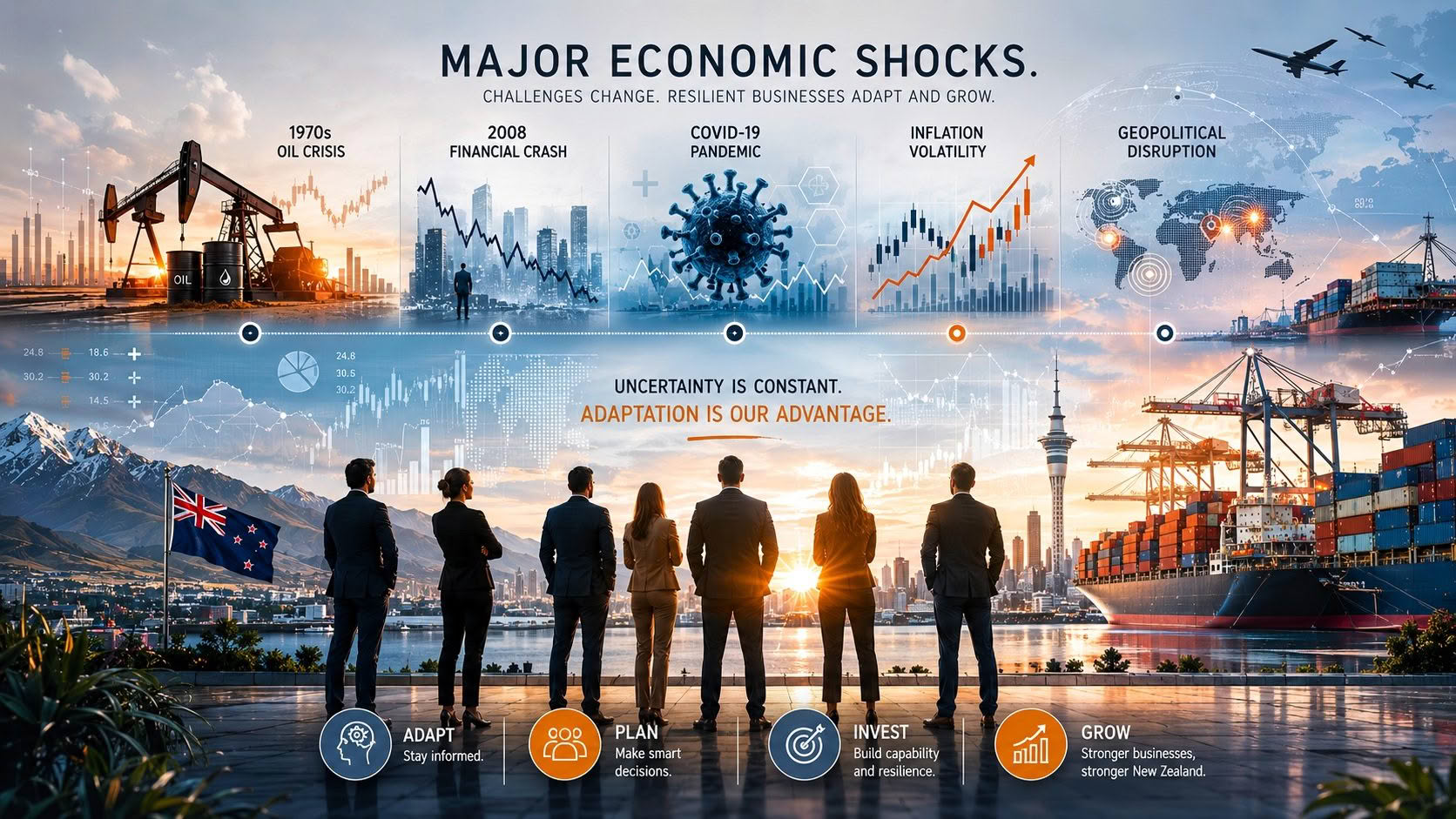
“Certainty — there is no certainty,” Alexander told the audience. Instead of a long-term steady path, economic history tends to unfold as a series of shocks and adjustments.


Over the past five decades, New Zealand and the global economy have repeatedly been disrupted by major events: oil crises in the 1970s, the 1987 share market crash, the Asian financial crisis in the late 1990s, the Global Financial Crisis, and more recently the COVID-19 pandemic. Each event reshaped economic behaviour and forced businesses to adapt.
Today, Alexander said, the latest global shock — geopolitical tensions affecting energy supply — is once again influencing the economic outlook. With oil markets under pressure, the global economy faces potential cost increases and uncertainty around supply chains.
New Zealand, like many countries, remains heavily dependent on global energy flows. As a result, businesses and households will likely adjust their behaviour if energy costs rise significantly. This could include changes in travel patterns, business operations, and consumer spending.
Despite these challenges, Alexander emphasised that the New Zealand economy entered this period with some positive momentum.
Economics, he explained, is often built around models that rely on assumptions about stability and predictable outcomes. But the real world rarely behaves so neatly.
“Certainty — there is no certainty,” Alexander told the audience. Instead of a long-term steady path, economic history tends to unfold as a series of shocks and adjustments.